
|
Good morning, Mrs. Levenson
They [my parents] were married in Baltimore. She went homeand his mother, of course, was still there, and his family. His uncles and aunts, and sister and brother, everybody was in Baltimore except him. So the wedding was in Baltimore, and then they moved to the house that Motherit was renovated and it was the same house she came as a bride. She came from the city, and shed walk down the street, and Daddy had brought a bride, and everybody would say, Good morning, Mrs. Levenson, Good morning, Mrs. Levenson, and shed go with her nose in the air. Daddy said, Nachanah, its not like Baltimore, you speak when people speak to you. Youre in the South now. They all know you, they dont mean any harm. It didnt take her long, she caught on. But she was from the cityyou just didnt talk to people unless you were properly introduced. You didnt know them, you didnt talk to them.
Greenhorns
Mrs. Banov would call on the women. Mrs. Banov, Mrs. Berlin, Mrs. Patla, Mrs. George Birlant, his motherall from downtown. They would visit the greenhorns, the women, and the men would visit the men and give them advice about what to do, and who to buy from, and what kind of merchantwhat you could sell, what you couldnt. They helped them with advice, you know. Not so much money, but advice. Thats how they got started.
Up-to-Date
FA: Mama died, she was pretty young too. She was very up-to-date though, very up to date. She wanted to speak well and she used to tell us when we would come home from a party or a from a dinner, what did I say wrong and how do you pronounce that word, I didnt know how to pronounce it. She was very forward in learning. She didnt want to be a foreigner.
NA: A greenhorn.
Perfect English
FA: When they had the grocery store, my mother used to have a black girl, teacher, to come in after she finished teaching, to teach her. Theyd go upstairs and shed read to her and do that to improve her. Tell me whatever I say wrong, dont let me say it, tell me about it, I want it to be right.
This man in Charleston, he was a miser. He was older but he had a lot of money, Hyman Bluestein, on the corner of King and Radcliffe, and my mother was a beautiful woman. He said,you have to learn how to speak English because he wouldnt go with you anywhere without English, they dont speak Jewish over here and they dont speak Russian, youve got to speak English.
And so my mother had a black school in back of where we lived near the grocery store. The teacher used to come at night when they closed the store and she used to teach her English, perfect English. Read, write, everything. And my mother was very proud of that. She could, you know, she was in America now.
NA: She [the teacher] was a black woman.
FA: A black woman, I think. There was a black school right in back and she came and taught my mother.
Heggs
But Sam [Banov, my father] was more of a frustrated lawyer. He was an instinctive doctor but he wasnt a frustrated doctor, he was a frustrated lawyer. Every young Jewish lawyer that came along he advised them on what to do. He was into politics. I told you he was remarkable in this connection. He was one of about half a dozen or less Republicans and he had a little hand in patrons but he was also very active in ward politics in the Democratic side. There was no Republican party in those days. There was only the Democratic party except for patronage. So he was in both camps. And he got by with it for some reason. He knew how to handle himself. And he had a combination Russian accent, Southern accent and Manchester accent because he learned his English in Manchester, England. He never said eggs, he said heggs. He had a few little British mannerisms and he also spoke with somewhat of a Southern accent but it was overwhelmingly Russian and yet he mixed with the mayor, he mixed with people on that level. He was quite a modest man but he knew who he was and he was aand in a quiet way he was assertive and quite a remarkable guy.
A Broken Accent
Ill tell you how he [my father] died. He was visiting my sister Annie. She lived upstairs over the store and she had a great big porch that went all aroundyou know the old-time homes. It was on Shabbos and he was spending the weekend with her. He had a big Torah with the table and he was reading. My father probably knew hundreds and hundreds of pages by heart. He was a scholarthey dont have many like that todayI guess in New York they do. My sister went out there to give him a glass of water or something to drink and he had already fell over the Torah and he was dead upstairs in Annies house, in Annies porch.
You see, my father could have been a rabbi in the biggest city in the United States, but he had one thing that kept him from it: he could never master the English accent. He spoke with a broken accent. The synagogues that would have taken him wanted a man that spoke perfect English, that was the problem. And thats what he was suited for, because he was not suited for a businessman. He could have been a great rabbi, but he didnt have the English language.
Spell Congress!
AU: I had to bring her to Charleston when they wanted me to run for mayor for the first time. Four times I was re-elected. But for the first time, one of them says to me, Well, Harriet, didnt she come from the old country? We thought about it. She wasnt a citizen! And she studied and studied, and we came in about 1950. So she could vote for me in the first election, she had to get her citizenship papers.
HU: After studying and studying, I knew everyyou know what they asked me? Spell Congress! That was all! For this I had to spend all of that time. Oh, well. Yes, I [memorized] everything!
AU: Yes, all the presidents!
The Secret
From the Union Daily Times, Friday afternoon, October 1927. Theres a photograph of Israel From, and the text says:
To tear loose from the land of your fathers, leave all the surroundings of child-hoods happy days and jump from Lithuania, in Northern Europe to Union, South Carolina, is no little jump.
Then to realize that you are burning all bridges behind and that you are landing in a strange country, without money or knowledge of the language, nothing between you and darkness but your own determined efforts, requires unbounded confidence in your capabilities and plenty of physical energy.
I. From, Dry Goods and Notions, is a household word in Union County: a fair price and courteous treatment has made it so. Mr. From discovered this worked in 1879 and discovered Union in 1905. He began business by peddling and in 1908 opened up a dry goods business which has been a growing success ever since. Living below your income with a sufficient margin to add to the business is the secret.
Mr. From was married in Worcester, Massachusetts, in 1905 and came directly to Union. They have two boys and four girls who are trained and educated to represent the best in American thought and effort.
Thats an American thought, thats what he was after. They loved this country. My mother had a picture of George Washington hanging in our house and a picture of Edison cause she remembered when the electric lights first came. Those were her two heroes.
Kinship and Comradery
Well, I know there were Jews here from the early 1800s, but those Jews seemed apart. The Jews that came in the early 1900s all felt some kind of a kinship and most of them had businesses on King Street. They saw each other up and down that street every day. They would see each other in the temples. The children went to the same schools, the same synagogue, the same Hebrew schools. There was some kind of a comradery and a kinship there. I think that was very unique. They may have had it in the larger cities, in the neighborhoods in New York, but because this was a small town, it was unique. Everybody knew each other, everybodyin some ways it was very good and in some ways it was not so good. There was a lot of gossip, and a lot of jealously about this persons child and that persons child and whatever, which is natural. Ive found out in my long life forhuman beings are that way. But there was something very good about it. It might have been the feeling that they could rely on one another if there was something dreadful happening to them. After all, most of these people came a long way with nothing practically, to make a new life and there is something else I would like to say. They were dedicated to make a better life for their children. They were very hard working people. And most of them accomplished what they wanted to accomplish. Their children have done very well in this country because of them. I think they all had to be very courageous.
Yiches
We were not ever prosperous in Charleston. We had a wonderful affiliation with the very best of people in Charleston, but in the old countrydo you know what the word yiches means? It means class. And Charleston is that kind of city today, I know that. They still go back to what you were. I know moneys very important, but in Columbia they dont look to see who your great-grandfather was. In Charleston and Savannah they do.
Good People
Upper King Street. When you got down past the Citadel, I mean, on King and Calhoun, it was all status. And my father was very strong on that. He says dont do anything unusual because they know your Jewish and everyone will be thought less of and we dont want that. Let them know youre good people.
They didnt want Jewish people there on Ashley Avenue because there werent many there. It was Christians next to us and on the corner was Poulnots that has Kerrisons Department Store, and my father went to him and said, If you do not desire us to be here, we can sell it and we can go somewhere else. He said, Mr. Ginsberg, youre welcome to come, were happy to have people like you. And from then on if Kerrisons, you know, accepted us, everybody could.
We werent ashamed that we were Jewish people. But theres a lot of Christian people, you went to school and they said, Oh, youre a Jew girl, my family dont like me to play with Jews. So, we didnt hang around with them too much. They let you know that youre beneath them.
You do your part and Ill do my part.
We did speak English at home. None of usthis is crazynone of us really learned towe certainly understood Yiddish, but we dont speak it fluently. We use words. Sometimes, if I couldnt make my mother understand something, I would try to think of a Jewish word. My mother and father spoke Yiddish, but we spoke English in our house. My father spoke beautiful English with no accent; see, my mother was always at home. She loved her home. She wanted to be sure she had three good meals every day for her children. She was a good wife, kept a good house, and my father said You know, it depends on the head of the house. Some men expected their wives to come and help, but some men My father figured, I can pay somebody to help me in the store, but I cant pay somebody to be a good mother to my children, six children at home. You do your part and Ill do my part.
Table Talk
He [Papa] could read some Hebrew, but shes talking about Yiddish. His mother spoke Yiddish, you know, it was table talk. Everybody in the family spoke Yiddish. When I went up there as a kid, six, seven years old, I used to learn knife and fork and plate and this sort of thing. They just spoke Yiddish in the house so he must have spoken Yiddish at that time. But he never spoke it down here. We never Yiddish was never spoken down here.
Yiddish
When they didnt want us to understand what they were saying they spoke Yiddish. My mother knew Yiddish from her family, of course. [My father] spoke Yiddish. He probably didnt know Russian, he only knew Yiddish, I think. I dont think he knew Russian. Although he may have. But the thing is that if he knew it, he forgot it, because he was only eleven or twelve when hehe never used it. He would never refer to his home, except that he was from this town. He must have had some unpleasant experiences there as a kid. Never talked to me about his home city, about his home village or town.
English Only
When my grandfather said that thats a past life, he wouldnt even speak German, would not allow it. The only time he ever spoke German to my grandmother, which I understand she understood, was when they wanted to say something that they did not want my father and aunt to understand, then they would speak in German. Other than that no German or Yiddish or anything was allowed or spoken in the house.
Dutch
The nickname Dutch comes from my youngest uncle, Bill Rosen, who was helping my mother out when she was in business. I was three years old and I looked like the girl on the Dutch Cleanser can, he said, so he called me Baby Dutch. Through the years, the family dropped the Baby, but then when I was in high school, some relatives would write Dear Baby Dutch for years. Now that Im seventy-five, I have a little trouble with the name, but Im going to stick with it.
Ilsa
There was a family called Kohn, David Kohn. They had a ladies ready-to-wear on Main Street and a very nice one. And they were known for their hats when women used to wear a lot of hats and gloves and all. But anyway they were definitely from Germany because one of the nieces came over and her name was Ilsa Kohn. And I fell in love with the name and when my daughter was born my father was gone by that time and his name is Isaac. And I tried to think of an American name to go for Isaac. And I named her Ilsa. Everybody said, where did you get that name? And I was almost hated to say it came from Germany.
Sacrifice
My mothers name was Jenny. My fathers name was Abraham. Mendelson is the family name. I couldnt carry on with my education. I had a younger sister, Gussy. We let her go to high school and she came back telling the fancy names that are available to the youth. Nowadays you hear more of it. But at that time it was terrible to use a word like that. So my dad sat her down and told her, Gussy, were giving you the opportunity to get the education that Sarah wanted. She stepped out of the way to let you go. And if you are going to bring in these kinds of words, that kind of language, you cant go back. Its a choice you have to make. Well, it worked and she finished with honors. And I never did go back to go to school. This is the best I can do. Thats how I learned English. Partially in the schools and then from reading and listening and that helps. And here I am.
Thats Not a Name
My mother was too busy to take me to school, because she had a tiny baby, so she sent me with my brother, Sam. I walked into the school and they said, The first grade. Of course, everybody knew everybodyit was a little town, they knew who I was. What is your name? My name is Elke. Thats not a name. Yes, maam, it is. What is your name? My name is Elke Levenson. Go home and ask your mother what your name is, cause Elke is not a name. I came back the next day and told her my name was Ella. Very upset young lady.
Waltz into Morning
My schoola small school is a wonderful thing. They taught music; in the public schools we had music, but being a girl, my father wanted his daughter to be accomplished, so I had private music lessons, I had private dancing lessons, I had private art lessons. He wanted to make a lady out of his daughter in the worst kind of way, and see that she had all the accomplishments. So if youre in all these music things, youre always on the stage. They had operettas. I did the Charleston on the stageI did, you know. They always put you up on the stage if you were in the music department. One time, I guess I must have been all of fourteen or fifteem, my mother [for] some reasonfor a recitalhad made me a red evening dress, and they decided that I must do a waltz with the best-looking man in high school. I was so thrilled I thought I couldnt live. This best-lookingmuch older than meyoung man in high school and I danced til three oclock in the morning. We waltzed on the stage. I thought heaven had come. He was gorgeous.
Ashley Hall
I went to Ashley Hall. I went first to Ms. McGinnis kindergarten. I went there until I was five. I went there when I was three and four. And when I was five years old, my mother enrolled me at Ashley Hall cause my birthday wasnt until February and I wasnt, you know, couldnt go; and after I was there for a few weeks they called my mother and said that they didnt realize that I was only five and I shouldnt be there. She says, Well, youve already got her now, Im not taking her out. But she always felt that the reason for that was that I was Jewish. There was only one other girl in the lower school and that was Riney May Bodne. She and I started together. One other Jewish girl was there and that was Roslyn Banov, who is Leon Banov, Jr.s sister. She was in the upper school. And mother said she didnt care if they didnt want me or not I was gong to stay there cause I was there, and I stayed there three years. But there was always that undercurrent. I always felt that I was not wanted there but it didnt bother me. I liked it and I was doing well in school. I had all my friends and I was friendly with a few of those girls, and still am friendly with some of them to this day. There were the Stoney twins, who are Mrs. Arthur Stoneys children. She recently passed away. Nancy Backer, who was Nancy Stevenson, who was your Lieutenant Governor. She was in that class.
Public School
They picked on every little thing, they wouldnt excuse you for anything, and we stayed home for every religious holiday. In my day you didnt go to school on Rosh Hoshanah, Yom Kippur, Sukkot, Simchat Torah. The first two days of Pesach, the last two days of Pesach. You didnt go to school. And they maybe scheduled tests, you know, did different things like that. Well, I stayed there through the third grade and we lived across the street from Bennett School so it just became more convenient for me to go to school across the street. After all, they werent going to put me back a year because I had started school too young. She already got me through that part. And another thing, mother thought that by my being an only child, she was afraid I would only see one side of life. Cause we have a very comfortable home and so she thought that I ought to see a little bit of everything. There were only girls at Ashley Hall too and they were all from, you know, pretty comfortable homes. So my first six weeks at Bennett School in the fourth grade I remember vividly. I cried every day. I had never been in a class with people like that. There were children from the orphan home there. See, the orphan home was only two blocks from where the school, was on the corner of Calhoun and St. Philip. The school work was entirely different. I had never been taught cursive writing. We only printed at Ashley Hall. Our math was not as advanced as the public school, which is surprising, isnt it?
The teachers name was Alice Mooran and I loved her to death, later. Called my mother and told her that I was just not keeping up. And mother said, Well, I dont understand that. I was a straight A student at Ashley Hall. She says, And she just seems to be so unhappy. She sits here and cries every day. Well, the reason I was crying and the reason I wasnt keeping up is, it was just so strange to me and I was afraid. So mother said, Well, you give her a chance. Shell catch on.
Well, the second six weeks I made honor roll. You know, by that time I got adjusted to it, but it was a very traumatic change going from that little class of, what did I havemaybe fifteen children in my class, to a class of thirty-odd. Number one it was overwhelming to me. And then I loved it, absolutely loved it cause there were activities I could do and there were a lot of children to play with. Then they had a problem with me. For some reason or another mother said I kept losing skates, I couldnt hang on to a pair of roller skates. And I would leave the table in the middle of a meal and disappear and she finally found out what was happening. It was my first experience with children who didnt have things. So every time I got a pair of skates, Id give em away. And I would take food from the table and go give it, you know, to somebody. I think she was very smart to have done that with me.
A Jewish Picnic
Momma would do things like this: Bubba was in high school here, but the teacher went out of the classroom. When he came back in, there was a big hubbub going on, pandemonium going on. He got real mad and he saidit was a manhe said, What in the world is going on here? It sounds like a Jewish picnic. Bubba was so hurtBubba was the kind that he would not say anything, but he was terribly hurt by that. Came back and said, Momma, he said that. Why would anybody say a Jewish picnic? Theyre no different from any other picnics.
Momma said, Whos that? Momma calls him up right awayMomma wouldnt hesitate to do things like that. She felt confident who she was. She would always say, I know who I am. I dont have to pretend to anybody who I am. I am what I am, and if you insult me, I tell you, Ill turn you straight. She called that man and she said, Could you come by? I want to speak with you. She didnt go therethat was the part I thought about in later years. Its so funny. Never occurred to her that she should go over there to him, and he was the principal of the school. She said, I want to call this to your attentionI didnt hear her, but she told me thatThis is going to be a great surprise to you, that I ever heard this story, and I know youre not going to be able to say why in the world you said it. I just want to explain to you how things go
She said, Little do you realize how your words affect the children whore listening to you. She said, I know youre a nice person. I know you very well. Youre a good principal and youre even-handed with the children, and I know youre not any more prejudiced than anybody else, but there are words, there are things that people say, without ever stopping to think of what theyre saying, and would this wound some poor little child thats listening. And she said, Thats what you said.
He didnt even know or remember hed said [it]. He said, My goodness, I cant believe I said such a thing, but I could have said it, cause its an expression I know. She told me he said, I dont know what in the world made me do thatI feel so terrible. Momma said he was like, Ohhhhh, Lordknocked out, couldnt speak. He said, I dont know what to say to you, how to apologize. I feel so terrible. What do you want me to do? She said, Nothing. I want you not to say it again. Thats all I want you to do. And I want to point out to you that there are always people in a group who are specially hurt by some little thing that you never even think about, that the majority never thinks about, whatever it is. Maybe its that their nails are dirty every day, or something else. Dont embarrass people by saying things thatpointing out that theyre different. She said, Just always think twice. She said, Bubba came home very hurt, but I told him you didnt mean anything by it. He says, Well, thank you. And she said, Thats all there is, thats all. I just dont want you to forget that. And he never forgot it.
Number One Cadet
Tell you an experience at Clemson that relates to Yiddishkeit. It was a tough military school when I went. Freshmen, the heads were shaved, you were called Rat, like VMI, Citadel. I worked hard. I wanted to achieve. Some of the Jewishness may have been a motive there. Because it was a gentile world in those days. So, I was a second ranking junior my junior year and the colonel, a regular military establishment there, an army colonel, a couple of majors, captains, sergeant, probably twenty there, called me up at the end of my junior year before I went to ROTC camp in Alabama and said Chaplin, gave me at ease, and said sit down. He said, You should be the cadet colonel of this corps next year, number one cadet, but youre not going to be. I didnt say a word. He said, Dont you want to know why? I said, Yes, sir. He said, Because youre a Jew. He said, Weve got about four Jews in this cadet corps and life would be made miserable for you and so youre not going to be cadet colonel.
Now, he was trying to do me a favor by explaining. He didnt have to say a word. When the promotions came out posted on the bulletin board I would have seen Chaplin, G., cadet lieutenant colonel and I would have figured well, number two not bad, you know. He wanted me to know that I really should be number one but he wasnt going to permit that because he thought my life would not be bearable, that the idea of a Jew heading, in effect, a non-Jewish cadet corpsnow, were talking about 1934, you know. Sixty-one years ago. So, you were made aware. I went to one reunion I think about fifteen years after graduation, maybe twenty, and two reactions. The first was what am I doing here with these old bastards. This guy is showing his teeth in, this guy is hinky dink. We had a cocktail party, our class. There were several classes there having reunions at graduation time. There was some drinking. A guy comes up, puts his arm around me, says, Chaplin, I want to tell you something, always liked you even if you were a Jew. I didnt say thats mighty white of you. I said, Sure, pal, lets have another one. What am I going to do, get into a discussion?
The Fraternity
Growing up here, I grew up in a community where there were no Jews, except when we went to the Sunday school, but my neighborhoodIm talking about the people I played with, the boys I played withthere was never any indication. I must admit when I got to high school, when [the students] came from the city all together, there might have been some comments or remarks behind my back, but I was never quite aware of them.
I have never put my head in the sand, so I am not a person of that type. I have always been rather realistic and I think I am fairly well-informed about a lot of things. I did not encounter things of this nature til I went to Furman. A friend of mine wanted me to join his fraternity. Fraternity rush came and went and he told me that he didnt realize that Jews were not allowed to join this fraternity. Well, I felt like telling him that I know of one who wouldnt join your fraternity. You know that famous Groucho Marx statement in which he was told he was admitted into some exclusive club. And he replied that he wouldnt belong to any club that would have him as a member. And I thought that was more of a statement, not on his character, [but] on [how] he characterized that club. And thats the way I feel too. Im poor but proud, maam.
Quotas
In those days, it was very difficult for a Jewish person to get in medical school. They only permitted two Jewish persons in each class of the Medical University for many years. There was a restriction on the number of Jewish students they could have.
For many years they restricted the number of Jewish students that would go to Harvard. A lot of the large schools had restrictions on the number of Jewish students that would be accepted each year. They didnt want it to be known that it was a Jewish school. Or they didnt want too many Jewish people becoming doctors or being competitive or for whatever reason they had. And for a long time in this community there was a sort of self perpetuating situation where the doctors children would be the ones who got preference. Thereafter I believe that each county was permitted to have two [students] come to the Medical University. Apparently if you had enough political pull, even if you were Jewish, you could get in from that county.
Waiting My Turn
We had three Jews who have been president of the State Dental Association. And in this state, to do that, you got to realize, thats pretty damn good. The first one was Jack Rosen, the other ones Leon Feldman, and youre looking at the third one. And Im willing to say thats probably whats going to be the three Jewish presidents of the State Dental Association for a long time. Part of it will beI have to blame on maybe my Jewish friends, theyre not being active enough in it. Youve got to do your share. Now, the three Ive mentioned, we did our share. We got active in, you know, your local group, and therefore you got promoted. And you say, is there anti-Semitism? Yes. I can talk about that one, yes.
We are divided into four sections or districts, four [dental] districts in the state. This one is the coastal, and so Jack was president in 1955 I think, something like that. Then it came up four years later and it was going to be either Leon Feldman or myself. I always pride myself on thisI stepped backbecause I could have had it just as easy. They offered me the position of being on the State Board of Dental Examiners and I didnt want it because, number one, it wasnt my temperament to want to give exams and have that kind of responsibility of picking who was going to do this and all that. I was part of the nominating committee, I had served as the secretary-treasurer of our district, so, as you know, in any organization, the nominating committee controls everything.
So, we decided that two Jewish boys in a row was enough, you know, and I said, Well, I dont mind waiting my turn, what the hey. Anyhow, we put in another person in between me and Leon. And then when it was my turn, we got a message delivered to us froma couple of my friends told me about it cause it wouldnt have been to mebut dont yall have anybody else other than Jews to represent the coastal district? Fortunately enough, the group that they were telling that [to] wasnt the ones that were listening. So, what they did, they went behind our backs you might say, and they organized an ad hoc sort of little group that was going to derail the nominating committees choice. A close friend of mind, his name was Alvin Steinberg, Jr. Unbeknownst to him, he didnt know he was part of the schemehes not Jewish. Hes called more Jewish than I am, you know, by names. And his ego allowed him to run, you know, they convinced him that he ought to run. They were pushing. My dear close friend who was counting the votesyou know how many votes I won by? Ever heard that proverbial statement that one vote counts? If Id have voted for my friend, you know whatd have happened.
The Ackerman Act
This is my father-in-laws office. He also had the same kind of a storyhe came out of Latvia, I think, or one of those places, also for the same reason, and he had been practicing in New York, and he came down and practiced in Charleston, and this was his office. While I was overseas he had one partner who died of cancer, so when the war was over and I was going back to Pennsylvania to practice. Thats where my home was and thats where my practice was, thats where I knew everybody. I was refereeing basketball and football games, and I was Chairman of the Young Republican Club and had a good little practice. And my father-in-law, after he lost his partner, asked me if Id consider staying here with him.
I said, No, Im not going to practice here. He said, Why not? I said, First of all, I dont want to take the bar over again. I said, I had a hell of a time passing it in Pennsylvania, it was hard enough, and Im not going to take another bar exam here. He said, Why? Youre smart, you dont have to worry about it. I said, I dont know how smart I am, but I have been out for four years, and Im not going to study for that. And beside, its too hot for me down herethey didnt have air-conditioning in those daysand I dont like the way you treat the black people, and, I said, [you] got big roaches about that big around. Have you ever seen the roaches running around here? Theyre horrible. Theyre all over everything. And you got mosquitoes, which I hate. No reason for me to stay here. Im going back to Pennsylvania. First of all, Im going to be a big fish in a little pond over there. Everybody knows me there; I dont know anybody here. But most of all, I just dont want to take the bar over again.
My wife was one of four daughters, four girls. He had no sons, and she was the last of the Mohicans, cause the other girls had all been marriedand no lawyers in the familyso my father-in-law was bound and determined Id stay here. So he went to Columbia. Youve heard of Sol Blatt?
Sol Blatt was a Jewish man, but [his wife] was converted out of Judaism into a Protestant or a Catholic. He and a fellow named Edgar Brown ran the state. Daddy went to him and said, Sol, I got a son-in-law who practiced law in Pennsylvania for two years. Incidentally, we have a reciprocity act with Pennsylvania and South Carolina. If you practice for five years, you can be admitted to [practice in] the other state without taking the bar. He said, What can you do for me? [Sol] said, Dont worry about it. We got an act passed by the legislature which said that anybody who practiced law before the war, and then went into the service, you tack on whatever time they were in the service to the amount of years they practiced, so you get the five years. So my two plus four made six. They called it the Ackerman Act. One lawyerin Laurens, South Carolinatook advantage of it besides me.
The Masons
My fathers name was Isaac, his first name. As soon as they came to America they dropped their family name because they were told nobody understands Russian and Jewish, you have to learn to speak English and so everybody will understand you. Thats right. And we were proud of it, we werent hiding from it, but they didnt understand us, thats the only trouble. And then we all spoke English. And my mother spoke English. And my father, he went to all the meetings. He becamewhat was that big organization? They asked him to join. The Masons.
Elks
I didnt join the Masons. I dont think most of my generation belonged to it. My brothers belonged to it. Oh, the Elks was even more important. The Elks was more important for integrating the Jewish and non-Jewish community and I didnt belong to that. Fellows like Jack Krawcheck were active in that. My brother Buster was active in that. I think the Ellisons were active in that. Sam Berlin was probably. There was a great deal of interaction there.
YMCA
On Sundays, next to my dads Carolina Shoe Company, which adjoined Max Citrons wholesale dry goods, there was a vacant lot between that and Park Street. A little bit rocky as I recall. The Jewish kids played football there every Sunday, pickup football. I was one of the smaller ones and Id get knocked down and start crying and one of these bigger guys would pick me up and comfort me and assure me that I was fine and all that stuff. The Jewish kids pretty much stuck together. I think I was sort of an exception because I fell in love with the YMCA. They had a pool, gym, and basketball. There was a time before I left Columbia when I was, I guess not older than a year after bar mitzvah, when I ran a gym class on Saturdays for underprivileged kids. They treated me like God, you know, and I had to stand in the shower and make sure they were absolutely clean, inspected their feet before they could go into the pool. It was a great experience. I also was the city ping-pong champion. The YMCA was sort of a haven for me. Columbia High School was right around the block but I used to go even earlier when we lived in Shandon and I was in junior high. When I left Columbia High School after two years, to move to Greenville, I quickly went to the YMCA. That was my home.
Basketball at the Y
I was amazed in later years thinking about it, but when we moved to Race and King Street where the Sacred Heart church was, all our friends were Catholic. They had a gym, an indoor basketball court, which was unusual. Most of us were playing basketball in the open, a playground court, and this was an indoor basketball court. Id go over there and play every day. I was on the team. Wed go downtown and the priest would take us downtownFather Murryhill. He was with us for practice. He had an open convertible Buick and hed take us down to the Y when wed play. No one ever suggestedI was the only non-Catholic on the team, and no one ever said anything and I didnt even think about it.
The Swim Team
I was very good in sports. Extremely good in sports. I used to swim South Atlantic Team with the Stuhr girls, Usher, and with Bobby [Danny?] Jonesthey named the park in North Charleston after him. We used to swim together with the South Atlantic Team. We didnt even think about swimming like they do today for the Olympics. We didnt evenI dont even know if they had an Olympics at that time. I know they had a South Atlantic Team. We used to swim in North Carolina and Charlotte. We used to go to Florence. And we used to, believe it or not, we used to practice in the Atlantic Ocean. We used to practice off the Battery. Thats right. We used to swim out there.
Penny Poker
Okay. Mickeys [Sonenshines] mother and my mother-in-law were sisters. And my mother, my mother-in-law, Mrs. Breibart, Mrs. Feldman, and a Mrs. Goldin, G-O-L-D-I-N, Bella Wallaces mother, Frieda Bluesteins mother, and several other ladies would play poker from when I was almost an infant child until well into the 40s, until they began to, of course, separate by age. But they would play poker twice a week. Penny poker. And Wednesdays or Thursdays they would have a meal at each others house, whosever turn it was. Sunday was strictly for gambling. Penny poker.
The Leavening Agent
I want to tell you about Karl Karesh. Karl Karesh, from the time he was about ten years old, has been the president and leader and just about everything in the Jewish community. There was a little boys club called B.O.Y., Band of Youngsters, he was the president. We had somethin g called the Jewish Juniors Basketball Team, he was the captain. He was always the leader. Just a natural-born leader. And had a certain amount of magnetism, I guess.
Another thing that I should tell you about the Jewish community in Charleston, the great leavening agent was Hebrew school. We originally had the Hebrew school by the synagogue on St. Philip Street. Later they organized something called the Jewish Community Center which was a building bought from the Catholic community, where the Catholic community used to have a school there, Bishop England school. Then it changed over, moved over, the Jewish community bought it and it was constantly broke. I remember my father astounded the community. He donated a thousand dollars toward that community center, which was an unheard of amount. Whenever it was, 1925 or 6, something like that. This marked us as economic royalists because of the thousand bucks. And there were other people like the Berlins and Kareshes, some of them, not all, some of the Kareshes didnt qualify. But they were the relatively wealthy ones by the days standards. Then there were people, the children of the less affluential, who normally wouldnt have associated with the wealthier ones, except in that Hebrew school all people were equal. We were all subject to getting slammed by Mr. Glaser or Speck or one of those, see. And we all commiserated and we all played baseball together and when we got big enough we tried to get on the Jewish Juniors, which Karl Karesh was the captain of.
So, there was this great leaveningit didnt matter who you were, how much money you had or your father had, if you were good you made the team; if you werent good you didnt make the team. And if you were good in Hebrew school, whats his name let you recite favorably or he invited you to study Rashi with him, which was a commentary. Rashi was a commentary on the Bible and only the brightest ones could qualify for that. And not all the brightest ones gave a good goddamn, so they didnt go to it, but thoseit didnt matter if you were the candlestick makers son or the president of the synagogue. That was the great leavening agent. And that leavening agent carried over into social things cause when you had parties in the evening, it didnt make any differenceif you were in a two year range you went with the same group as a general rule and if you had the stuff and if you were socially knowledgeable you mixed in with them. And if you didnt, you didnt. You didnt mix in with them. But the leavening agent was ability, there was no question. Money didnt make any difference.
A Clothier
I had one experience with a boy who became a very close friend of mine. He used to run me home from high school because I was Jewish. He turned out to be a beautiful guy and we were very close friends for a long time. But thats the only real experience Ive ever had of being Jewish. Then when I went to work, first went to work for Jack Krawcheck, and he had a good business from downtown people, gentiles, I became to be known as a clothier through that connection. When I finally had my own, I went to work for Mr. Meyerson on the corner of King and George, which was right around the corner from the college, and we used to serve a lot of college people and we became lifelong friends with a lot of people from downtown who were not Jewish.
Race Street
I lived on Race Street. That has a variety of different people. Goyim different denominations. Jewish people also different denominations. I always said good morning to anybody that would show before me. Sometimes I would walk outside and I would miss the person who was there saying hello to me. I apologized and said Im sorry I didnt see you. And they would carry on a conversation like we were brothers and sisters.
And when I left Race Street, its a funny thing. The lady was watching for the mover to come and get me to Race Street when the house was ready. And she called me and asked me, why am I moving? We miss you so much. Youre our inspiration. Why did you decide to move? Well, I told her. We had an incident. Otto and I were sitting in the living room and all of a sudden we heard something like a shot. They had gone on the porch and crashed a window with a brick. And when we heard that both of us were scared. We started to look together huddled up. We finally came into the bedroom. My bedroom and Ottos. Its a good thing we had Venetian blinds. The window was crashed. And some of the glass came through the Venetian blinds because they are not permanently shut. And thats when we decided to call our children.
There is a Carondolet Alley about a half a block from where we lived between Rutledge Avenue and Coming Street. And nobody ever committed anything there. It was so peaceful. We had the property, I mean the land here. And my children started to work to get us over here. And thank God I had no problem. I, myself, didnt have any problems. It was just that they were going through the neighborhood. And I hated to leave. Some of the people from there still call me and talk to me. I lived there thirty-six years right across the Greek Church. I lived at 31 Race Street. I was so in love with that cottage. It was just for me. Especially after the children got married, I didnt want to go to a big place. So Maurice and Joan, Maurices wife, began to talk and do something about it. In 1967 we moved here on our fortieth wedding anniversary. And I have enjoyed living here. The people are very nice but they are not too sociable. So we dont visit each other too much. Once in a while they will come. Like I give donations to the heart fund, any kind of fund, so I go to their house and wait for the check to send off and thats how we meet and see each other.
Open House
I had a lot of Christian friends. At our house, if you wanted to take a drink, you could take a drink; it was open house. When the war was over, all my friends wanted to come to my house so they could have a drink, because they couldnt go home and have a drink. After that, after they all came to my house and had a drink, you had to go to church to be thankful, so we all traipsed to the Methodist church, and on the way out we stood about as far away from the minister as we could because we reeked of alcohol, Im sure.
Baptism
I went to a Methodist church because my neighborsin fact, the neighbor across the street, she had seven children and she had the minister come to baptize them. While they were being baptized, I headed over there. Ms. Violet told the minister, Theres a Jewish boy here, Mortie Cohens coming over here, what do we do? He said, A little water wont hurt him. I was baptized.
The Extra Angel
When I was a little girl, my little best friend across the street went to the Baptist church, and they needed an extra angel for Christmas, I was the extra angel. They need an extra one, Mother said, Sure, so I was the extra angel in the Baptist church. In the musicwe had these courses where you sang, and I hated that. We sang at the Presbyterian church. I can sing He Arose with the best of them. Thats the way it was in a small town.
The Goat Who Came to Dinner
Daddy was so good with livestock. We could ride on the road, and see a mule a half a mile or mile away, and Daddy said, That mule I sold that man in such-and-such a time, I know that mule. He could recognize animals like you recognize people, had just absolutely a knack for it. If it was on four feet, my daddy could recognize it. He couldnt remember your name, he didnt care what your nameyou know, he liked you fine, but he knew that mule out there in that field.
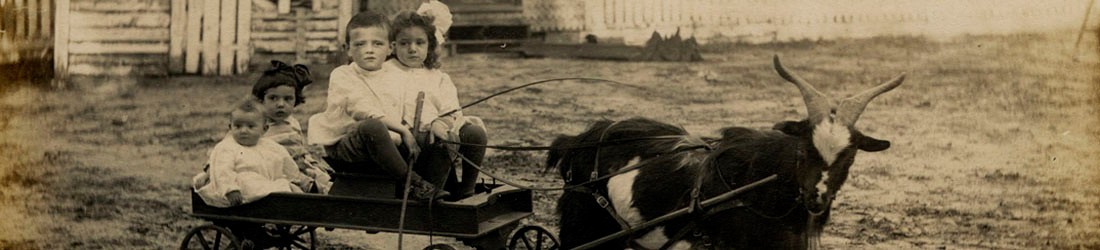
[Two of my brothers] inherited that love, they all love animals. Mother tells the story, whenshe had two boys and a girl first. My youngest brother is six years younger. Shed have Leonard and Sam on harness, and me in the carriage, and there was not a dog or a baby that my oldest brother didnt want to bring home. Every baby he saw, he thought we ought to take home with us, and every animal he saw. We had a goat, and they wanted to bring him in to dinner, and Mother said he couldnt bring him in to dinner. She said, He doesnt wear shoes, you cant bring him in. So they took their clothes out and dressed the goat up in pants and shirt and shoes and brought him in. Mother had a fit. We had goats. We had everything, I cant tell you how many kinds of dogs and cows and lambs. We took Sam up to Hopkins, to Dr. Max, and he said he had a bad stomach, had to have goat milk. Came back, Daddy bought two nanny goats, and my mother milked the nanny goats.
The Lure of Land
Most Europeans, if they are able, want to have landthey are deprived of it in Europe. Behrman said there is plenty of land down here. Im pretty sure thats how he got Papa to come down. Otherwise, we probably would have been buying Long Island instead of South Carolina.
Jewish Mayors of Georgetown
Well, I had a good friend here who was an insurance agent, and he had been talked into running for mayor, but he said he wouldnt run unless I ran for council. And so I ran for council, and he was elected and I was elected. And he died a month after he was elected and I happened to be mayor pro tem and I became mayor. I then ran three more times. Thats how I got into it. Meyer was elected to the legislature, and I didnt offer for re-election after he was elected to the [state] legislature [in 1962].
In 1948, I think Jews had been mayor since 1900had been mayor more than any other religion. Marks Moses was the first man that was, then it was Louis Ehrich, then there was Harold Kaminski. And then there was me.
Mixed Marriage
And the big, the good speech writer was Bob Figg. Robert Figg. I can remember when we lived on Rutledge Avenue when Strom Thurmond was running for governor. All of his speeches were written at 102 Rutledge in our breakfast room. Those men used to sit at that table and eat salami sandwiches and talk politics.
Sally [Figg, his wife] just wasnt very Jewish oriented. I mean she didnt know too much about Judaism. I dont think she was raised that way, you know. And Bob Figg was a Baptist. I can remember my mother telling me that he thought it was terrible that his children were being raised with no religion. So he used to read, have Bible readings at home. He just felt like his children ought to know about God. You know. But she never denied being Jewish or anything like that. I mean, she had some fabulous Jewish heritage. Very old, I mean one of the first Jewish families in the city. They must have come here in the 1700s.
|
Top |